Firstground Field Notes
Reading Your Creek
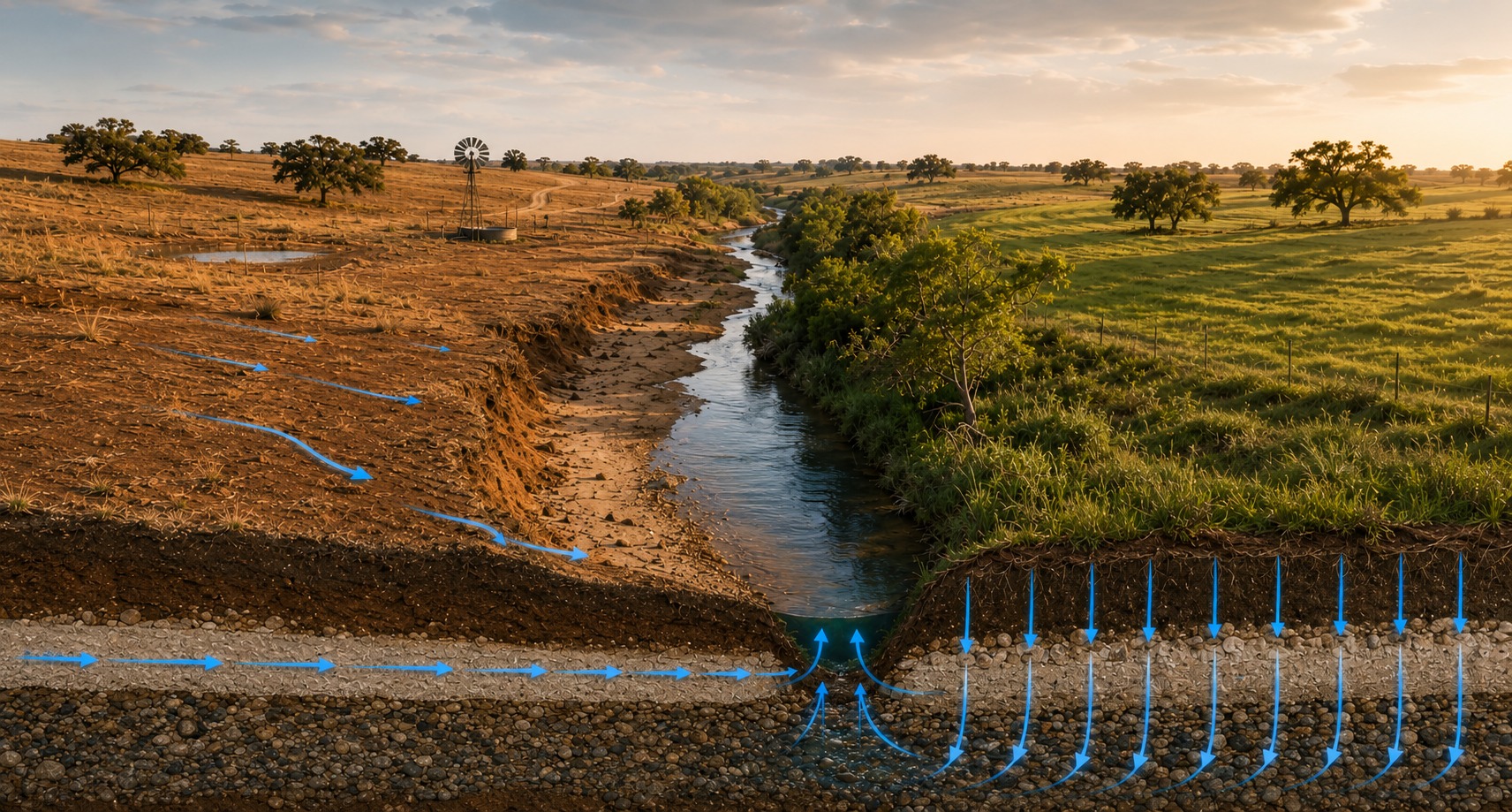
By the time I reach a client's creek, I have usually heard the first half of what it is going to tell me. The story starts at the highest ridge I can find when I come through the gate and runs downhill through grass cover, bare ground, hoof impact, soil surface, old erosion lines, and every place water has been encouraged to slow down or hurry up. The creek is not separate from that ground. It's just the affirming nod to the theory I've been building to that point.
Every now and then, it corrects me.
What the creek bank gives me is confirmation.
A straight vertical cut sends me looking uphill. Somewhere in that catchment, water is leaving too fast and all too often taking your best soil with it. The bank shows consequence. Sometimes that consequence comes from current management. Sometimes it comes from old damage that is still collecting interest. Most of the time, it is some mix of both.
An undercut bank does not scare me on its own. Creeks bend. Water cuts. That is part of their nature. What matters is the company that the bank keeps.
Is there deep-rooted vegetation holding it? Are the roots exposed and drying out? Is the creek laying material down anywhere, or only cutting deeper? Can floodwater still get out of the channel and spread across the bottom, or has the creek dropped so low that every hard rain stays trapped between raw and degrading walls?
A creek carving deeper every flood cycle tells a different story than one that bends and breathes. Once we have studied the shape and approach, we need to look at what is growing.
The plant community is a record for review. By the time I have walked your creek, I will have a pretty good idea whether your cattle have had free rein to graze your riparian areas and how much rest the ground has had between hits.
But I am not looking first at what is growing fifty feet back from the water. I am looking at the waterline itself.
That is where the creek tells on the land.
Here is what I am looking for when I walk a creek bank, and what you can start looking for on yours.
First, look at the bank geometry
Do not start with whether the creek looks kept or inviting. Start with its shape.
Is the bank sloped, rough, and covered, or is it a clean vertical wall? Is the creek cutting down, cutting sideways, or starting to rebuild? Are there fresh raw faces after every big rain? Are roots hanging in the air? Are sand, silt, leaves, sticks, and seed collecting on small benches, or does every flood seem to leave the place cleaner, deeper, and more wounded?
A vertical bank is not automatically a disaster. A steep outside bend can be part of a working creek. But a long run of raw vertical bank, especially with exposed roots, bare soil above it, and no place where sediment is being caught, tells me the system is losing ground.
Literally.
That bank is not just dirt beside water. It is a report card on how water is moving through the whole place.
Second, look at whether the creek can still reach its bottom
In a big rain, can this creek get out of its banks and spread water across the creek bottom, or is it trapped in a deep trench?
That question matters more than most people realize.
A connected creek can spend some of its flood energy across the bottom. It can slow water, drop sediment, feed grass, water trees, soak soil, and turn a hard rain into something the land can keep hold of.
A disconnected creek cannot do that. Once the channel cuts too deep, the water stays trapped between steep banks. It moves faster. It cuts harder. It carries more soil away. Worse than that, a creek sitting in a deep trench starts acting like a wick, pulling the water table down with it and drying out the pastures on either side even after the rain stops. The creek may still have water in it, but it has stopped doing some of its most important work.
It has stopped sharing that water with the land.
That is when a creek stops being a resource and starts becoming a drain.
Third, Look at what is growing at the waterline
Not the best grass in the pasture. Not the brush line way back from the creek. Not the pretty green strip that shows up after a rain. I mean the wet edge itself, where flowing water, exposed soil, hoof pressure, roots, and mud all meet.
That edge tells on you.
If the waterline is bare, slick, hoof-torn, and raw, the creek is losing armor. If cattle are standing in the same easy crossing day after day, the bank will usually show it. If every low spot is beaten into mud and every young plant gets grazed before it can build roots, the creek does not get much chance to heal.
Green does not always mean held. A bank can be green with plants that do not have the root system to do the job. Shallow-rooted annuals may cover the surface for a little while, but they will not hold a bank like deep, dense, water-tolerant roots will.
In this part of Texas, I pay attention when I see sedges, rushes, smartweed, switchgrass, eastern gamagrass, willows, buttonbush, and other plants willing to live close to wet feet and moving water. I am not saying every one of those plants belongs on every creek, and I am not saying their presence proves the system is healthy. Nothing out here proves anything by itself.
But plants like that can be workers.
They catch sediment. They slow water. They shade soil. They bind edge. They give the creek something to build against.
I am also watching what is missing. If the waterline has no young woody growth where it should, no grass with real roots, no sedges or rushes in the wet areas, and no protected edge except what the bank can hold by force, then the creek is depending on bare soil to do a root's job.
Bare soil is a poor employee.
None of these signs stand alone. Bank shape, floodplain connection, and waterline plants have to be read together. A creek can have one ugly bend and still be working. It can have green banks and still be cutting down. It can look rough after a flood and still be rebuilding in the right direction.
That is why I am not asking whether a creek is pretty.
I am asking what direction it is headed.
Is it catching soil or spending it? Is it spreading water or rushing it off? Is it building edge or losing it? Is the bottom still part of the creek's work, or has the water been trapped below it?
That is the read I care about.
Is this creek still part of your land or has it become a drain running through it.