Firstground Field Notes
I Built the Wrong Land Health Walk First
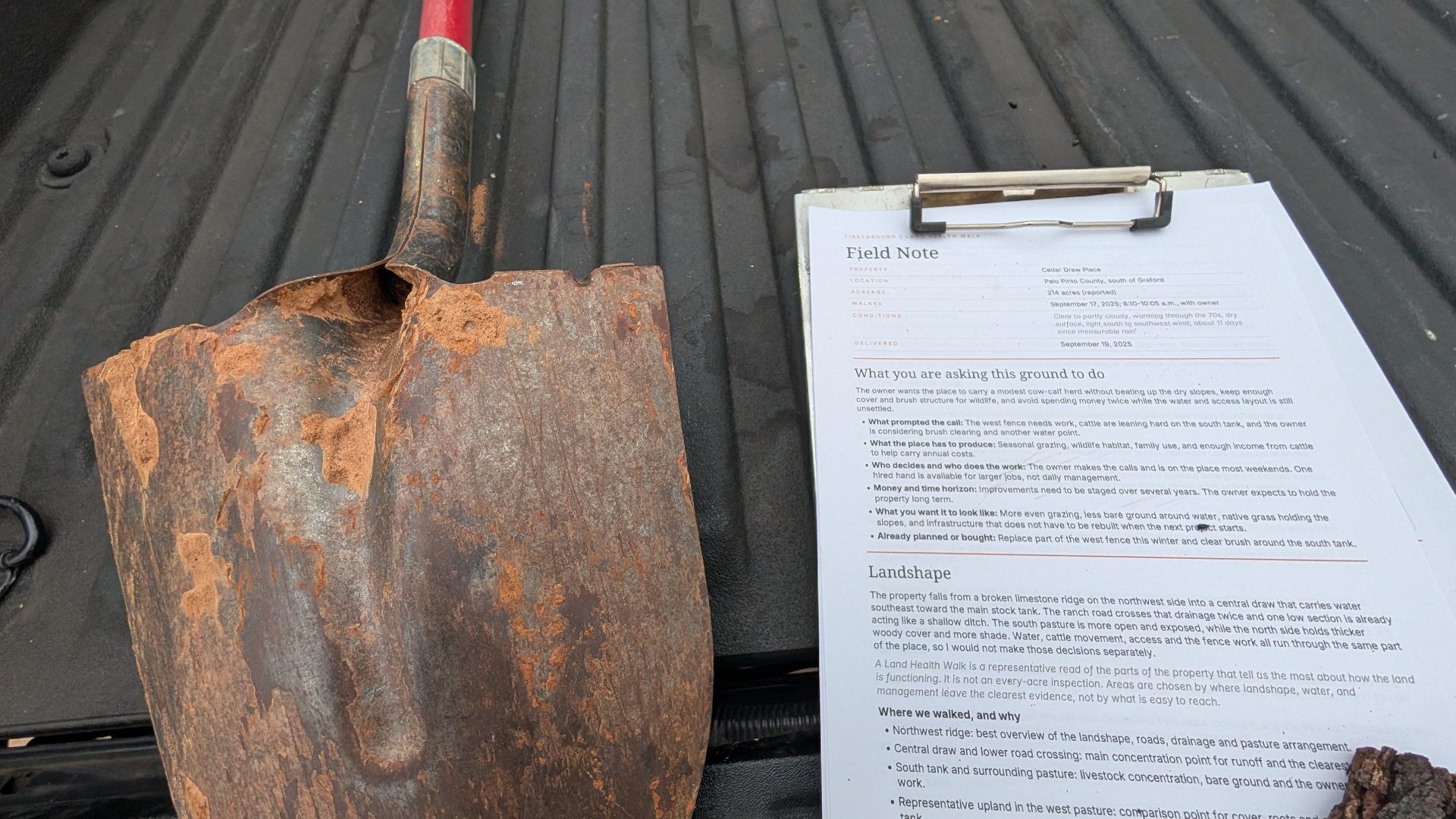
The first version of Firstground's Land Health Walk looked pretty good.
I had soil. Water. Vegetation. Grazing pressure. Infrastructure. Observations. Recommendations. Monitoring.
It was orderly. Defensible. Anybody who has spent much time around conservation planning would recognize the bones of it.
Then I worked it for a while and realized I had basically built another rangeland assessment form.
It looked great. Better than most. I am good at that kind of thing.
But at its core, it was still another rangeland assessment form.
There is nothing wrong with that kind of assessment. The Natural Resources Conservation Service has good reasons for inventorying land the way it does. Those categories bring rigor and give agencies and other practitioners a common language. I want a district conservationist to be able to read my work without wondering what the hell I was looking at.
It just did not really reflect how I think when I am standing on a piece of ground.
I had spent years learning Holistic Management, soil biology, Keyline and Regrarians design, grazing, restoration, and all the other pieces that tend to get lumped under "regenerative" these days.
Somewhere along the way I had gotten good enough at blending those ideas into familiar language that I could build a conventional assessment, sprinkle in bare ground, litter, recovery and biology, and tell myself I had built something different.
I hadn't.
So I went back through the people and work that shaped me before Firstground existed.
Allan Savory 's work made the first miss pretty obvious.
I had assessed the property and barely assessed the whole.
What are these people asking this ground to do? Does it need to make money, feed cattle, hold wildlife, raise a family, be sold in five years, stay in the family for fifty, or some combination of all of it?
Who makes the decisions? Who actually has time to do the work? What can they afford? What have they already bought or committed to?
The ranch is not the whole. The people, money, labor and quality of life belong inside the decision too.
Then I went back through Darren J. Doherty work and Yeomans.
I had organized observations with no real sequence behind them.
The way the ground is shaped tells me where water is going to move. Once I understand that, I can start making sense of access, trees, buildings and fences.
I have a lot more room to change soil through management than I do to move a road, pond or barn after it is already in the wrong place.
That meant the walk needed an order too.
I do not want to start wherever the gate happens to be and wander around collecting problems.
I want to understand the landshape first. Where is the high ground? Where does water start moving, concentrate and slow? Where do roads cross it? Where are cattle being pulled? What decisions farther downhill are already being shaped by what happens above them?
I might walk right past a bad fence if we still haven't figured out the water. No sense paying to build it twice.
Gabe Brown 's work caught another one.
I had a box for soil observations.
In the field, I have to get that shovel in the ground. I can't just look at the surface and repeat what the NRCS soil survey told me.
I want to see the roots, structure, aggregation, moisture and cover. I want to know what is alive, what appears to be missing, and whether what I see in the soil agrees with what the plants are telling me.
I love maps. I love lab work. I can disappear into soil chemistry and biology longer than is probably healthy.
I still want a reason before I order a test.
A shovel can tell me a lot before I start paying for lab work.
Allen Williams ' work had me looking hard at scale and response.
Before I tell somebody to do something across 2,000 acres, can we try it on 20?
What are we going to watch?
What would make us change course?
Can one move improve several things at once?
If I cannot tell you what would make me stop, I probably have no business telling you to scale it yet.
And Will Harris keeps bringing me back to economics.
Whatever I recommend still has to work for the people paying for it.
If the place cannot pay for it, the labor is not there, or the owner cannot keep up with the management, I do not care how good the ecological case looks on paper. I should not be handing them that recommendation.
Waiting is not free either.
Erosion keeps going. Poor water distribution keeps causing problems. Bad infrastructure keeps shaping the decisions that come after it.
Those costs belong in the conversation too.
Once I put all of that back into the method, the Land Health Walk changed.
None of it needs to show up in the client's field note as a lesson in Savory or the Regrarians Platform. It should show up in the way I walk the property and the calls I make.
What are you asking this ground to do?
What does the landshape tell us?
What is the water doing?
What is happening with nutrient cycling, plant cover, recovery and community change?
How are the animals affecting it?
What does the soil look like when we open it?
What is the infrastructure helping, and what is it fighting?
Then I have to make a call.
What do you do first?
What waits?
What should you avoid for now?
Where does the next dollar do the most good?
What am I not ready to call yet?
I do not want a Land Health Walk to produce recommendations just because somebody paid me and expects a list.
Sometimes the useful answer is, "Don't spend that money yet."
Other times I need a deeper assessment before I can tell you, or I want to try something on a small piece and watch what happens.
The current Walk is 90 minutes to two hours on the ground, followed by a plain-English field note.
That note tells the owner what I observed, what I did not observe, what I think the ground is doing, what I cannot conclude yet, and what I would put first.
If somebody reads my note and it’s just a list of ten more things to buy with no idea what goes first, I missed the mark.
I could have shipped the first version and nobody would have called it bad. That is probably what bothered me most.
If I am going to charge somebody to walk their ground, the value cannot be how many boxes I can fill out.
It has to be in the calls I make. What matters now. What can wait. What I still need to know. What they should not spend money on yet.
And it has to come from the thinking that shaped me in the first place. Otherwise I am just handing them another form.