Firstground Field Notes
What Are We Asking the Farm Bill to Do?
I started reading the Farm Bill because I wanted to know what was in it. I had heard people praise it, heard people complain about it, and I had opinions of my own.
I work with people who make a living from land. I have to understand the programs, money and rules sitting around that land.
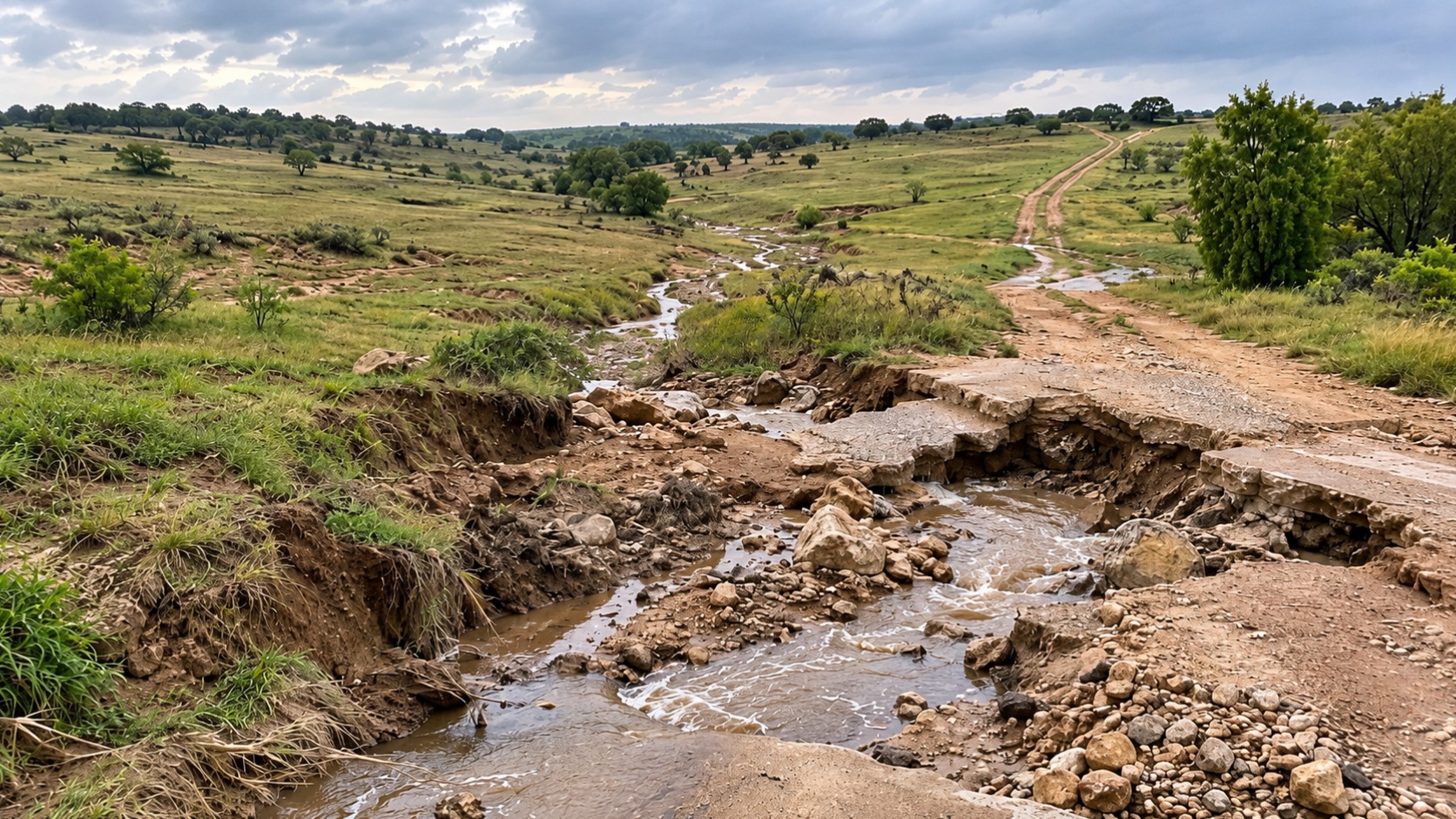
The farther I read, the more I kept thinking about a washed-out crossing.
A washout tells you where the water won. It does not tell you where to start. You still have to walk uphill. Look at the catchment, the road, the flow path, the soil, the grazing, whatever is feeding it.
Fix the crossing if it needs fixing.
Then figure out why you are back there with a loader after the next hard rain.
A lot of farm policy started reading like the repair bill.
Some of those repairs matter a hell of a lot. Drought, fire, flood, disease and bad markets can put a good operation in trouble fast. There are families still on their ground because a program gave them enough room to make it through.
I kept wanting to walk uphill.
Right now we are still working from an extended 2018 Farm Bill
The Agriculture Improvement Act of 2018 has been extended three times. The remaining authorities under the current extension run through September 30, 2026.
That is today.
Congress also moved some major agricultural policy through the 2025 reconciliation law. Among other things, that law funded and authorized several large conservation programs through fiscal year 2031. The rest of the Farm Bill process kept moving separately.
The House passed H.R. 7567, the Farm, Food, and National Security Act of 2026, on April 30. The Senate has a different bill, S. 5526, the Agricultural Act of 2026. The Senate Agriculture Committee reported that bill on September 24 and it was placed on the Senate calendar.
There is plenty to compare between those bills. I want to do that.
First we need a better question.
What are we asking this whole thing to do?
It is a question that comes up all the time on land.
What are you asking this ground to do?
Before fence, ponds, brush, seed, grazing plans or testing make much sense, you need to understand the place and the people managing it.
Who makes the decisions?
What resources are actually available?
What does the operation have to pay for?
How much labor can it carry?
What is somebody trying to build here over the next ten or twenty years?
Holistic Management calls this defining the whole under management. At its simplest, that includes the decision makers, the resource base and the money available or that can be generated. The framework also recognizes that a whole sits inside larger wholes and affects smaller ones.
That seemed like a useful way to look at national farm policy.
USDA is part of the whole. So are farmers and ranchers, their families, agricultural land, lenders, processors, sale barns, input suppliers, packers, local businesses, buyers and taxpayers. Rural communities depend on a lot of that machinery. Soil, water and biological function sit underneath all of it.
Policy changes something somewhere in there.
The next question is what else changes when we do it.
Walk uphill
Take disaster assistance.
A producer gets hammered by drought or wildfire. Getting money into that operation quickly can matter.
Then keep going.
How exposed was the operation before the disaster?
What would make the operation more resilient next time?
Did insurance work?
Did the producer have enough forage reserve?
Was there somewhere to move animals?
What happened to the fences, water and markets?
Which of those problems belongs to that individual operation and which ones are bigger than anything one producer can fix?
Land access has its own version.
We have programs meant to help beginning farmers borrow money. Credit accessibility belongs in the question.
What can the ground actually earn?
Can that income service the purchase price?
Who else is bidding on the land?
What happens when a retiring farmer would like to sell to another working farmer but the numbers only work for the neighbor adding another 5,000 acres, an investor or a developer?
Cattle markets have their own version. Risk-management tools deal with price movement. Then look at the market around the producer: how many practical buyers are there, how is price discovered in that region, what processing capacity is nearby, and how much leverage remains once the cattle leave the gate?
Processing grants deserve the same walk uphill.
Where is slaughter capacity missing?
Why did it disappear?
Can a new plant get enough animals through the door to cover labor, inspection, refrigeration, wastewater, insurance and everything else required to stay open?
Who is going to buy the meat?
The plant still has to stay open after the grant is spent.
What are we measuring?
This is familiar territory in conservation.
Acres treated are not the same thing as land improved.
Miles of fence tell us how much fence got built.
A contract tells us a contract was completed.
Those are useful records. We still have to go look at the ground.
Government has its own versions of those measurements. Dollars obligated. Loans made. Contracts signed. Acres enrolled. Practices installed.
Those numbers tell us what the program did. We need to know what changed because of it.
If we are spending public money to support American agriculture, the condition of American agriculture ought to be somewhere on the report card.
Can working farms and ranches support the people operating them?
How much off-farm income does the household need to keep the operation going?
Can somebody new get into agriculture without already owning land?
When a producer retires, who is buying the acreage?
How many buyers can producers reach?
How much independent slaughter and processing capacity exists within a reasonable haul?
Can smaller producers reach institutional and regional markets?
What happens to rural businesses as agricultural ownership and production consolidate?
What happens to the land after conservation contracts end?
How often are we rebuilding the same thing after the next drought, flood or fire?
Those questions are messier than counting contracts. They tell us more about whether agriculture is actually getting healthier.
Other people are already working on parts of this
National Farmers Union (USA) has been pretty direct about where it sees the problems. Its members are asking for a stronger farm safety net, more competition, mandatory country-of-origin labeling and more domestic market development. This month its president said family farmers are dealing with rising input costs, concentrated corporate power and a safety net that no longer reflects the current farm economy. That is National Farmers Union's diagnosis, and it is pushing Congress for broader changes than the current bill alone.
Farm Action is spending a lot of its effort on competition and the market structure around independent producers. Its Farm Bill work includes regional processing and distribution, federal food purchasing and other ways of creating more routes between independent producers and buyers.
American Farm Bureau Federation is putting more emphasis on getting a full five-year Farm Bill completed, maintaining risk-management tools, expanding markets and giving producers more certainty instead of another short extension.
Those organizations do not agree on every diagnosis or every answer.
Good.
American agriculture is too large and too varied for any one organization to have the whole thing nailed down.
The useful part is what happens when those questions land on the same table.
What happens to producer income?
What happens to competition?
What happens to land ownership?
What happens to processing?
What happens to resilience?
What happens to the ground?
There are some things worth pulling apart
Regional processing is near the top of the list.
We can talk about local and regional food all day. Somebody still has to slaughter, cut, wash, pack, store, aggregate, transport and sell it. That infrastructure needs enough throughput to live after the ribbon cutting.
Federal food purchasing could help create some of that dependable demand. Schools, military installations, hospitals and other public institutions buy food every day. The question is how much of that purchasing power could support regional production and processing, what already exists, where it has worked, and what problems show up when government procurement gets involved.
That runs straight into competition and price discovery.
More processing capacity does not mean much if producers still have too few buyers, poor access to those markets or no real leverage when it is time to sell. The harder question is where those bottlenecks are and whether new infrastructure actually changes who can buy, who can sell and who gets to set the terms.
Land succession may be bigger than all of it.
We say we want another generation on the land. That gets hard fast when the earning capacity of the operation and the price of the ground stop making sense together. Farm Service Agency lending, taxes, easements, seller financing, retirement and who gets first crack at working land all belong in that conversation.
Conservation spending belongs here too.
If taxpayers help pay for conservation work, we should be looking at what happened to water movement, soil cover, erosion, plant communities, habitat and the operation's ability to manage the place after the check was cashed.
Then there is data.
Virtual fencing, remote water monitoring, pasture measurements, herd records, remote sensing and whatever comes next are going to build detailed operating histories of farms and ranches.
That operating history could become a real asset for producers. Who controls it will decide a lot about what that asset is actually worth.
Can the producer keep a local copy?
Can it move somewhere else?
Who else gets access?
What happens if the company gets sold or the product disappears?
Producer control does not stop at land, cattle or markets anymore. Information belongs in that conversation too.
The answers need more work
I have ideas.
That is not the same thing as having answers.
USDA-supported regional market infrastructure deserves a hard look. So does local procurement. Long-term land financing, succession tools, competition enforcement, better ownership transparency, regional processing and conservation programs tied more closely to land response all deserve a serious look.
Every one of those can go wrong.
A processing plant can burn through public money and close because it never had enough throughput.
Easy credit can add more buying power to a land market that is already too expensive.
Procurement rules can help build a market and bury small producers in paperwork at the same time.
Conservation payments tied too tightly to measured outcomes can punish good managers for a drought they did not cause.
Rules aimed at concentration can catch family operations they were never intended to catch if they are written badly.
Those are not reasons to stop asking hard questions.
They are reasons to do the work before deciding the answer.
What are we trying to change?
What is feeding the condition we are seeing?
Who has to carry the decision?
Where is the weak link?
What happens somewhere else when we pull this lever?
How will we know if it worked?
What would make us change course?
Those are the questions I think the Farm Bill has to survive.
There is too much here for one Field Note or LinkedIn article. The pieces need to be taken one at a time. Buyer power. Land succession. Regional processing and markets. Credit. Conservation. Agricultural data.
Before arguing for another program, we need to understand the ground underneath the program.
The washout is easy to find.
I want to walk uphill.